Challenge
Dr. Kristen Nichols knew that many of her teachers needed additional support to improve their classroom management skills, but she did not have the time or resources to work with each of them individually. Many of her teachers, especially those with little classroom experience, struggled to keep students on task and effectively teach course content. Dr. Nichols began to seek solutions that could offer these teachers individualized guidance to improve students’ focus and retention.
Result
By the end of the partnerships, participating teachers were comfortable implementing the strategies they practiced in coaching sessions. Before coaching began, students in their classrooms struggled to focus and absorb content during lessons. On average, only 58% of students in the nine participating teachers’ classrooms were focused and on task, and only 43% were mastering course material. After coaching, the average number of students on task had increased to 88%, and the number of students mastering course material had increased to 76%. Additionally, 100% of participating teachers reported feeling more confident in their instruction.

Customer At a Glance
976 Students
40.5% African American
31.2% White
19.9% Hispanic
8.4% multi-racial or other63.2% eligible for free or reduced lunch
Large population of Spanish and French ESL students
Student-teacher ratio: 13:1
Solutions
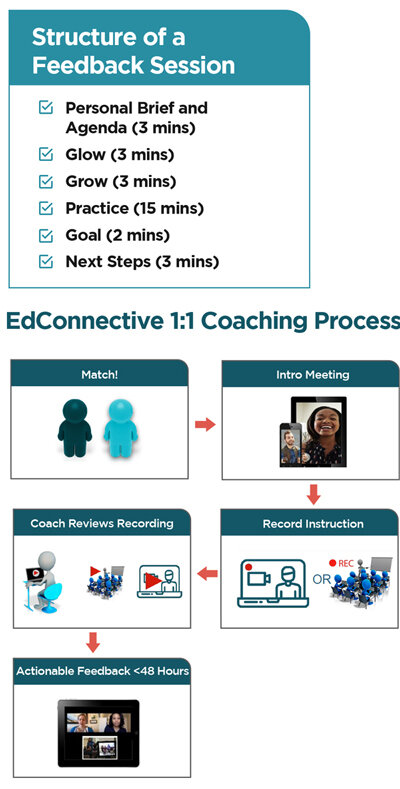
Nine Crossroads teachers were matched with an EdConnective virtual instructional coach to receive personalized one-on-one support. Once a week for eight weeks, teachers recorded 20-minute segments of classroom instruction, which were then reviewed by their coaches. Together, teachers and coaches discussed the recordings in 30-minute, practice-based virtual coaching meetings. Coaches offered individualized feedback and guided teachers through practice and implementation of specific “teacher actions.” Teacher actions are data-supported strategies used to improve classroom management, to attain specific outcome goals.

Background and Challenge
Dr. Nichols recognized that some of her teachers, particularly new teachers and career-switchers, were struggling with classroom management, instructional practice, and student engagement. She knew that instructional coaching could help address these issues, benefitting both her teachers and the students in their classrooms. However, as a busy administrator, she did not have the time to work one-on-one with every teacher. Although she had access to several in-building coaches, they did not have the capacity to provide teachers with ongoing, intensive, and individualized support.
Dr. Nichols also believed that her teachers needed access to professional development opportunities that were positive and non-evaluative. She felt that some of her teachers did not seek professional development as often as they should in order to continue improving their teaching practice, and she wanted to encourage a change in this mindset. Additionally, she indicated that her teachers lacked professional development opportunities in which they had agency over their developmental goals, and that they didn’t often have the opportunity to receive immediate, non-evaluative feedback.
Solutions
Dr. Nichols was first introduced to EdConnective via her participation in the Elementary School Principal Association of Norfolk (ESPAN). Several of her ESPAN colleagues had used EdConnective coaching in the past, and after hearing about their experiences and speaking with EdConnective CEO Will Morris, she decided that EdConnective coaching would be a good fit for her needs at Crossroads.
Dr. Nichols selected nine of her teachers to participate in EdConnective coaching, focusing on new teachers and career-switchers, as well as veteran teachers who were struggling with certain aspects of classroom management. These teachers were individually matched with EdConnective coaches based on EdConnective’s proprietary 15+ factor coach matching algorithm, which is informed by a survey completed by each teacher.
Once each teacher had been matched with an EdConnective coach, the coaching process began with a 30-minute introductory session between teacher and coach. This introductory meeting serves to build rapport and establish partnership goals. Following this meeting, each teacher recorded a 20-minute video of classroom instruction and shared it with their coach. Each coach then reviewed this video in-depth to collect data on student engagement, as well as to identify teachers’ strengths and areas for improvement.
This information was then discussed with teachers in 30-minute feedback sessions. In each feedback session, teachers were given an actionable strategy to move towards their partnership goals, as well as ample time to practice the strategy through modeling and role-play. To end each session, specific goals were set for the following session, and the next recording and feedback session scheduled and agreed upon.
The coaching process lasted 8 weeks in total -- after the week of the introductory session, teachers uploaded a classroom recording and met for a feedback session once weekly for 7 weeks.